
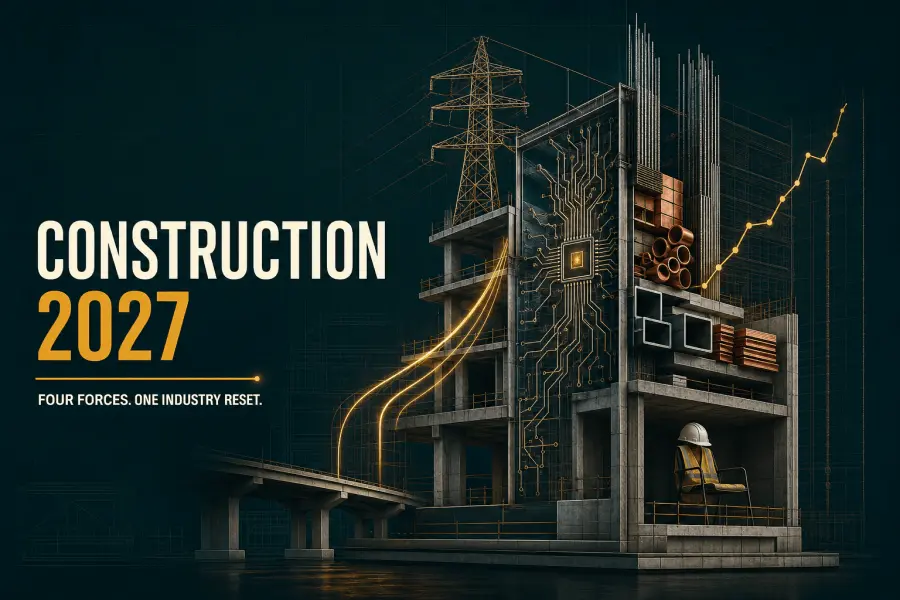
Ask ten different construction executives what’s coming in 2027, and you’re likely to get ten different answers, because four different trends are colliding at once: an infrastructure supercycle in AI data centers, a geopolitical shockwave rippling through commodity prices, a labor shortage that no longer looks like a distant threat and an AI adoption curve within the industry itself that has finally crossed the threshold from pilot programs to production. All are already factoring into conversations around construction in 2026, and what follows are thoughts on where each is likely to go and what to position around.
The easiest number to grasp is also the most obvious: capital expenditures on data centers are set to roughly double throughout the coming year, according to the research firm Allianz, reaching peak values of around $500 billion in 2024 to more than $1 T at one point in 2027. But those researching the sector know that the real value to be found will not be in the data centers themselves, but the transmission infrastructure required to power them; investment in this category alone is set to reach $230 billion annually by 2027, up from $174 B in 2024, because power is a more constrained resource than capital is.
All major analyses of the sector this year point to this simple fact: while capital expenditures are expected to accelerate, power availability, grid connections and permitting will prove more critical constraints on the industry’s growth. A telling insight from conversations with tech executives this year is that tech companies are financing their own power plants to reach the necessary capacity, an unusual sight within the construction sector, but one that highlights the value to be found within the grid and power generation segments, particularly in connection to data centers.
The major risk to consider with this segment is that it is a capital expenditure-heavy bet on continued large-scale spending by hyperscaler firms on AI-specific infrastructure, and there are already signs within the industry that this expenditure could slow.
The military escalation in the Strait of Hormuz in late February 2026 sent immediate shockwaves across the global economy, forcing international engineering and construction firms into instant damage control. Within weeks of the transit bottleneck, steel distributors around the world slapped projects with price surcharges ranging from 18% to 30%. Supply constraints deepened as global crude steel output fell 4.2% year-on-year in March 2026, while essential commodities like copper, aluminum, and cement saw simultaneous price spikes driven by compounding energy and freight costs.
This sudden surge follows the long-tail financial fallout of the 2022 Russia-Ukraine war, which permanently altered international raw material pipelines. Worldwide, baseline construction material indexes sit roughly 30% to 50% higher than pre-2020 levels. Forecasts indicate these elevated risk premiums will drag well into 2027, highlighting a grim new reality for the sector: severe, geopolitically driven supply disruptions are no longer temporary anomalies, but an embedded cost of doing business.
For construction firms looking to budget for 2027, the practical takeaway from this trend is that stability in material pricing is unlikely to be seen for some years to come, due to the combination of increased demand and the prospect of additional geopolitical incidents throughout the next 12-18 months. It has, in part, already caused shifts to tendering practices, with shorter validity periods and clauses for price fluctuations becoming more commonplace, as well as forward buying and contingency planning being built directly into project budgets. With regards to specific materials to watch out for, steel, copper, aluminum and cement all fall under the category of materials that see frequent price fluctuations on a global scale.
While much has been made of how little construction companies have adopted AI technologies, that narrative has shifted dramatically within the last year; ServiceTitan’s 2026 industry outlook found that 38% of contractors already report measurable business benefits from AI, up from 17% the year before. Meanwhile, the Associated General Contractors’ outlook for 2026 found that 61% of contractors are already utilizing AI in some capacity or planning to increase their investment, compared to 44% the year before.
The focus of AI adoption is currently on narrower applications within the construction lifecycle, rather than industry-wide transformation, but that is precisely what makes these gains both notable and durable: the value these programs deliver across the sector is undeniable, and the investment is being made to continue reaping those rewards.
For example, automated estimating platforms that utilize AI are reaching accuracies of 85-90% compared to manually-prepared estimates, while also reducing takeoff time by 70-90% on clean sets of plans. Meanwhile, AI-assisted scheduling is reducing total project durations by 10-15% across the board, according to PwC’s most recent analysis of the space. One field task that has seen an equally striking reduction in time spent is field layout, which has been reduced from five days to one day on average by layout robots in documented use cases.
Generative design, autonomous machinery, and fully-autonomous general contractors are valuable pursuits that are still very much in development, but as of 2026, the practical construction applications with demonstrable ROI are limited to the aforementioned domains of estimating, scheduling, and safety monitoring at this time.
The other major trend to consider when planning for 2027 is the labor shortage across skilled construction trade positions, which has fueled the rise of many of the other trends mentioned. The Associated Builders and Contractors put the number of new jobs required across the industry at 349,000 in 2026 and 456,000 in 2027, with the need for additional workers accelerating throughout the 2020s, expected to reach a cumulative shortfall of nearly 1.9M workers by the end of the decade. Meanwhile, Deloitte’s 2026 construction outlook estimates that 2M skilled craft workers will be needed by 2028 if current trends continue, due in part to a large wave of retirements across the industry.
Many of the other trends seen across the industry in 2026 can be understood as a response to this particular challenge, but the most immediate impact it has on construction outlooks for 2027 is the need to rethink the construction lifecycle with reduced staffing in mind. The need to adopt automation in construction is no longer a question of “if,” but rather “when.” Robotics in construction is a small market at present, forecast to be worth only $1.3 billion in 2026) but is projected to reach $11.14 B by 2040 but it is following a labor shortage trajectory which suggests that these figures will continue to grow at roughly this rate through 2027.
With all trends considered, there are five particularly compelling areas of focus that are set to define the construction outlook for 2027, but to better understand why these trends bear further consideration, it helps to first highlight the areas that are less compelling or less useful to research at this time.
While the major stories across the construction industry in 2027 are set to focus on the aforementioned infrastructure supercycle, it is worth noting the ways in which this spending binge will not lead to lasting changes across the industry in 2027. First and foremost, it is important to remember that the focus will be on power infrastructure rather than data centers themselves, at least at the start of this supercycle.
While the data centers that will ultimately utilize this new infrastructure are certainly valuable, the power generation and transmission segments will see much of the near-term capacity constraints, making them a safer long-term investment than many of the firms being built directly around the AI boom. Secondly, there are already signs that the focus of this supercycle will eventually turn towards other sectors within civil and commercial construction, as the ConstructConnect 2026 industry outlook highlights a need for growth across many segments, not just data centers within the AI space.
The value to be found in this insight is that, despite the obvious draw of an infrastructure supercycle, those firms that want to grow in 2027 should spend more time looking at the adjacent sectors that are set to grow at a similar rate, but require considerably less investment to enter than a data center build requires.
A third observation is that while much is being made of the transformative potential of AI within the construction sector, many of its 2027 applications will be found in supporting roles within the construction lifecycle, rather than as end-user-facing solutions. However, these gains in automation will only be realized alongside an industry-wide shift towards adopting AI across the sector, which is already underway but has yet to fully arrive.
Finally, as has already been discussed at length in this outlook, the need to rethink the construction lifecycle around reduced staffing levels will see a significant number of firms adopt more robotics in 2027, particularly within sectors facing extreme labor shortages. While it may seem like a distant prospect to many, this shift is already taking place within the construction sector for skilled labor, where automation is being utilized in many facets of the work process, from layout to electrical work to safety monitoring.
Having discussed what is and is not worth watching, there are several compelling trends that are most worth exploring further as the industry looks ahead to 2027.
First and foremost, the major opportunities within the power generation and transmission sectors should continue to be prioritized, as these areas are set to see much of the initial investment from the upcoming infrastructure supercycle. Secondly, while the data centers driving this supercycle are certainly worth further research, it is important to remember that the supporting civil infrastructure will see much of the near-term capacity constraints, making it a safer long-term investment than many of the firms being built directly around the AI boom.
A third area of interest pertains to the use of AI-assisted estimating and scheduling platforms, which have seen rapid adoption rates within the industry over the last year. With adoption rates set to rise even further within the coming year, these applications are quickly becoming an industry standard, and those who fail to adopt them risk finding themselves at a disadvantage compared to their peers by 2028. Finally, it is crucial for construction firms to rethink their contractual and procurement practices around the volatility seen in material pricing, particularly when it comes to steel, copper, aluminum and cement, which are the materials that have seen the most dramatic price fluctuations over the last year. Having said that, those companies that wish to benefit from this price volatility should also rethink their approach to modular, prefabricated and robotics-assisted construction within the trades most impacted by the current labor shortage.
Driver Key Figure Source
There is already debate within the industry about whether there is a bubble around the current construction boom fueled by demand for data centers, but most analysts agree that there is little doubt about the capital being invested. The disagreement is centered around whether these valuations are sustainable should spending on hyperscaler infrastructure slow, but those positioning around the opportunity should focus on the power generation and transmission infrastructure needed to support these data centers, because the need for power is unlikely to slow for some time.
It is difficult to say with any certainty at this point, but prolonged disruptions to shipping and a prolonged geopolitical conflict could well see additional surcharges to material costs throughout 2027. Even if the current conflict resolves itself and shipping resumes normal operations, the pattern of periodic interruptions to global supply chains is unlikely to change for some time, due to the increasing frequency of regional disputes. With this in mind, it is safest to plan for volatility rather than stability in material costs.
It can be tempting to try and bid directly for work from big names within the tech industry, but most small and medium-sized firms would benefit from focusing on the supply chains these larger firms are utilizing, rather than competing directly with them. It is also worth noting that the labor shortage is likely to affect many of the skilled positions these larger firms are planning to fill with automation, so smaller firms should also look into adopting robotics for these specific roles.
Pumraw Consultancy tracks these trends closely, as understanding where the industry is moving helps us better serve our clients who require BIM and quantity estimating services, from large-scale commercial projects that utilize AI-assisted estimating to navigate volatile material costs, to smaller firms looking to scale their support offerings in response to a shifting market.

Please feel free to contact us for any inquiries or to discuss your outsourcing needs.
Copyright @ 2024 by Pumraw Consultancy
Web Design by Pumraw Consultancy