
If you’ve ever received a “final” cost estimate that fell apart the moment real bids came in, the problem probably wasn’t bad math. It was a mismatch between what the estimate was actually capable of telling you and what you used it for.
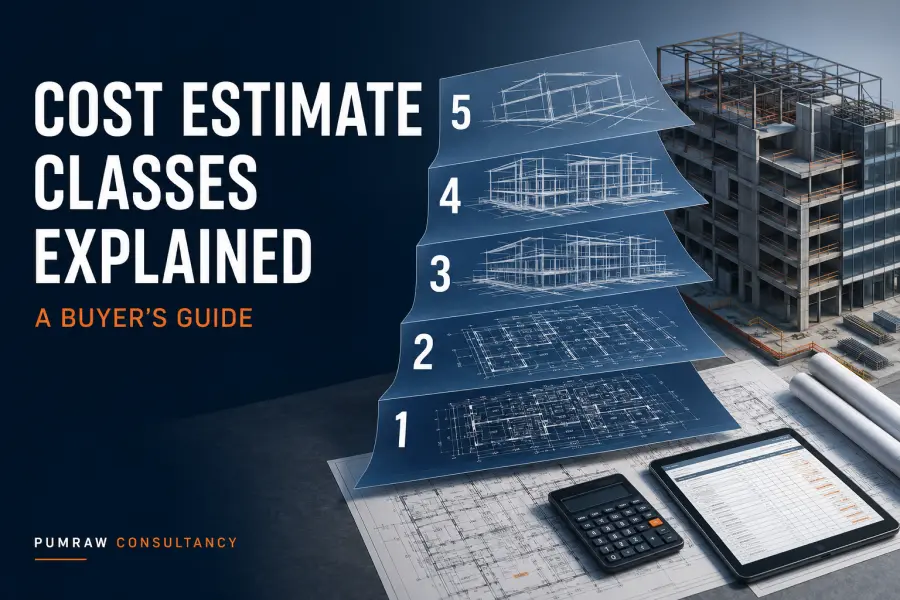
The construction industry has a standard for this: AACE International’s Cost Estimate Classification System. It defines five classes of estimate — Class 5 through Class 1 — based on one simple driver: how much of the design is actually locked in when the estimate is produced. More design definition means a tighter, more reliable number. Less definition means a wider, rougher one. Knowing which class you’re getting, and matching it to the decision you’re about to make, is the difference between a useful number and an expensive surprise.
Here’s what each class actually means, in plain English.Produced when almost nothing is designed yet — typically at 0–2% design definition. This is a ballpark figure based on program size, historical cost-per-square-foot data, or comparable past projects.
Use it for: early feasibility checks, initial concept screening, “should we even pursue this” conversations. Don’t use it for: budget approval, lender submissions, or anything you’d defend in a board meeting.
Produced around 1–15% design definition, once schematic design or an early concept study exists. Enough is defined to compare design options against each other, but specifications are still loose.
Use it for: comparing design alternatives, early planning-stage budgeting. Watch for: vendors treating a Class 4 number as if it were bid-ready. It isn’t yet.
This is the number that typically goes to a board, investor, or client for project funding approval — produced at roughly 10–40% design definition, once preliminary or basic design is in place.
Use it for: securing project funding, setting the budget the rest of the project will be measured against. This is often the most consequential estimate in the entire project — get it wrong here and every later decision inherits the error.
Produced at 30–75% design definition, once detailed design is well underway. This is the level a bid or tender package should be built on, and the estimate contractors are typically measured against for cost control through construction.
Use it for: bid preparation, contractor bid comparison, ongoing cost control during construction. This is the level most outsourced quantity takeoffs for bidding purposes should be delivered at — a Class 3 or 4 number quoted as bid-ready is a red flag.
Produced at 65–100% design definition, near or at issued-for-construction documents. This is the tightest, most reliable class — used to validate a bid or contract price right before it’s locked in.
Use it for: final check estimates, contract price validation. Rarely needed earlier in a project: requesting Class 1 precision during feasibility just adds cost and delay for a decision that doesn’t need it yet.
Before accepting a quantity estimate, ask one direct question: “What class is this, and what design definition is it based on?” A vague answer — “detailed estimate,” “accurate pricing,” “professional-grade numbers” — is the biggest early warning sign in this industry. A specific answer (“Class 3, based on our current 25% design set, ready to move to Class 2 once bid drawings are issued”) tells you the estimator actually understands what they’re delivering and why. Note too that AACE itself is explicit that the accuracy range for any class isn’t fixed — it depends on project risk and complexity — so a specific, well-reasoned answer matters more than a promised percentage.
| Class | Design Definition | Typical Use |
|---|---|---|
| Class 5 | 0–2% | Concept screening, early feasibility |
| Class 4 | 1–15% | Comparing design options, early planning budgets |
| Class 3 | 10–40% | Project funding and budget approval |
| Class 2 | 30–75% | Bid preparation, cost control through construction |
| Class 1 | 65–100% | Final check estimate, contract price validation |
Does a higher class always mean a more useful estimate? No. A Class 1 estimate during early feasibility wastes time and money on precision the decision doesn’t need yet. Match the class to the stage.
Can different parts of the same project sit at different classes? Yes — this is common. A locked-in structural package might support a Class 2 estimate while site work still sits at Class 3.
What class should a bid actually be priced against? Class 2 at minimum (Also depends on the inputs received from the clients at this stage). Anything estimated from Class 3 or 4 design definition should be treated as a budget range, not a number to hold a contractor to.
Pumraw Consultancy delivers quantity estimation work at named, agreed AACE classes from day one — no ambiguity about what a number is actually good for. If you’re evaluating estimation partners, ask us which class we’d propose for your project stage and why.

Please feel free to contact us for any inquiries or to discuss your outsourcing needs.
Copyright @ 2024 by Pumraw Consultancy
Web Design by Pumraw Consultancy